May 01, 2004

A Cub Experience

Donna has been suggesting for a long time that we tow a trailer on some of our longer trips, but I have been categorically refusing. I am not a big fan of towing, especially into challenging terrain. However, on a trip to the Barrington Landrover Lease last year, we met a couple who were camping quite comfortably, thank you very much, and we got talking to them about their trailer, which just happened to be a Cub. They were extremely positive about it, and started telling us about all the places they had towed it to over the years. Considering they had bought it second hand about 15 years ago, and had since towed it around Australia several times, I was quite amazed at what good condition it was in. They enthusiastically showed us in and around the unit, showed us the standard features as well as all the little extra modifications they had made, and insisted we come back when they were getting ready to go to see how easy it was to pack up.

I must admit it got us thinking a bit. Perhaps a camper trailer might not be such a bad idea, especially given that we were tending to do more of the long distance touring trips these days. Donna and I decided we might try and see if we could pick up a second hand Cub trailer at a reasonable price, so we started to scour the classifieds to see what we could find. We discovered two things. One was that it was incredibly difficult to find a good second hand trailer that was specced the way we wanted it, especially a Cub. They seemed to be as rare as hens' teeth.

The second thing that became pretty obvious was that the ones we did find were not cheap. They seemed to hold their value really well, and buyers were prepared to pay the premium prices for second hand trailers because they were just so hard to find. We looked at the idea of just hiring one when we wanted to use it but, apart from being pretty expensive, it was again very difficult to find one that was set up the way we wanted.

Logic kicked in and said since we would really like one to take on the Uluru trip, and given the excellent resale value and the fact that we had trouble finding a suitable second-hand one, perhaps we should just buy one, use it and then if we find it's what we're after we can keep it and if not, we can sell it for close to what it cost us. That way, we get exactly what we want and the whole deal will probably work out cheaper than hiring one anyway.

So with some typical buyer's nervousness, we went out to Cub last January for a look at what they had. We knew pretty much what we wanted in terms of design and weight, so after looking around at the various campers we were pretty impressed with a model called the Explorer. It is a bit of a hybrid model – classed as an offroad trailer, it was a heavy duty, lifted model suitable for some pretty rugged use, but not quite as kitted out as the full-offroad model (which was heavier than we were willing to tow). After some deliberating, we decided to go ahead with the purchase.

I must say that Cub was very cooperative in their approach and more than willing to make minor changes for us. We asked that the standard 6-stud axles be replaced with the Suzuki 5-stud wheel pattern. We also changed the standard 14” wheels with 15” wheels. (We would have liked to go to 16”, but they wouldn't fit without moving to the full offroad model, and we didn't want the extra weight) 15” wheels were not ideal, but we figured that so long as a trailer wheel could be made to fit onto the car in a pinch, it was a bit more security in an emergency. We asked for a few other minor changes, right down to the colour of the interior curtains and, wherever possible, Cub did their best to meet our requests.

After a long wait – manufacturing time for new trailers is approximately 3 months – we finally picked it up just before Easter. Ross Nichols from Cub took the time to go over the trailer with us, explaining all the bits and pieces, gave us a practice at opening and closing it, and made sure we were comfortable with it.

First excursion with our Cub was to Mount Yengo . It had been a while since I'd towed a trailer so it took me a while to get used to having it sitting behind the car, but we adapted pretty quickly. Towing it into the Yengo Station Valley was straightforward. Having the convenience of the flip-open camper with a built-in, roll-out kitchen made life really easy, and we thoroughly enjoyed it.

Second trip for the trailer was a visit to the Landrover Lease at Barrington Tops. Each time we use the trailer we learn new things about the best way to open it, the best way to get it level, and the best ways to camp with it. Having the kids' beds on the floor is a pretty easy solution but also uses up a lot of floorspace. We used the add-on awning for the first time and found it greatly expanded the living space around the trailer. Towing it into the Tops was a bit more challenging than Yengo, as the roads are rougher and the hills bigger and steeper, but there were no great dramas. I was really impressed with the way the trailer sits behind the car on the road, with the suspension easily soaking up the rough bits.

These first two trips made obvious a couple of improvements to the drawbar arrangement in order to make access to the tailgate easier. The jerrycan holder and the stoneguard were not really in the ideal position, so with a bit of engineering expertise from Troy Campbell, some modifications were made and the new arrangement proved much more workable.

The big test was of course the Uluru trip. 23 days of touring, the first week having a new overnight camp each evening, was sure to fine tune the process of setup and packup. We learned something new each day, making minor changes to the way or the order in which we did things. We tried different combinations for packing the inside of the trailer, and eventually got the process quite streamlined. Packing for 4 people over 23 days is never going to be a simple task, but the trailer certainly made life easier.

Towing was superb. By the time the trip came around, we had moved to a 2.7 litre XL-7, and the larger vehicle and more powerful motor made a noticeable difference. Indeed, the improved towing ability of the XL-7 was a major factor in deciding to change vehicles. There is no doubt that the XL is a much better tow vehicle than the V6 Vitara it replaced, even though the Vitara was pretty good already. There were plenty of times I had to actually remind myself that I had a trailer behind, such was the easy towability of the trailer and the smooth power of the XL-7.

After towing the Cub through the Flinders Ranges , up the Oodnadatta Track, across the MacDonnell Ranges and around the Mereenie Loop, I have to say it was a really effortless experience. The trailer tracks extremely well behind the car, and the shock absorbers on the suspension do a great job of reducing bounce and sway. It was nice to be able to pull into camp, release the clips and wind the top open to reveal a comfy double bed, ready to sleep in. The kids' beds were simply slid out onto the floor. Roll out the kitchen and we were just about set. It really did make life a lot easier on the road.

One of the throw-away phrases you hear from people with offroad trailers is “you can tow it anywhere the car can go”. I don't necessarily agree with this statement. There are plenty of places I wouldn't want to pull a trailer, but they are generally pretty extreme with lots of low range rockcrawling and the need to manoeuvre the car with lots of forward and reverse work. Forget trailers in these conditions. I also wouldn't like to be towing one in really steep, slippery conditions, or very soft sand for extended distances. Things could get pretty uncomfortable. But for the great majority of moderate 4WD use, over rough terrain, through bumps and dips, across shallow creeks etc, I can't see any great problems. The trailer pretty much follows wherever the car goes, with the Treg hitch coupling giving plenty of articulation for almost any angle. So long as the track wasn't so tight it required lots of reversing and critical line-picking, I'd be pretty happy to tow it over most terrain.

After 8000kms of corrugated roads, we had a few very minor issues – a bit of dust leakage, a cracked kitchen bracket, etc. Cub was quite willing to address these problems and fix them under the terms of the trailer warranty. Generally, I have been very happy with their aftersales service and support, and their willingness to listen to any issues that may have arisen.

So, is a camper trailer for everyone? No, probably not. There are lots of people for whom a trailer is not going to be the right solution. But for us, we find it fits really well with the sorts of things we enjoy doing. We can see ourselves using the trailer not only for 4WD trips where it suits the terrain, but also to take with us on holidays generally. Not everywhere we go requires offroad capability, but it's nice to know that we have a trailer that is just as much at home on road as off, and we can hitch it to the car anytime we like and just head off for a weekend somewhere.

Chris Betcher
DBZ00K

March 20, 2004

Creating the Right Image

I was having dinner the other night with three people from Tasmania and in the course of our conversation they asked what I had planned for the weekend. When I mentioned I was going 4WDing they all went conspicuously quiet. The woman to my left then told me that where she lives in Tasmania 4WDers are not very popular, that she often goes walking in a nearby National Park area and on more than one occasion has had to dodge and weave past people driving their 4WDs in a reckless and less than friendly fashion. I quickly added that I was with a 4WD Club, expecting that would convince her that we were different, but she replied that most of the “hoons” she comes across also seem to be part of organized groups as well…

I then mentioned that we would be visiting an area normally closed to vehicles through a negotiated access agreement between the 4WD Association and NSW National Parks, and that we would be assisting National Parks with some tree planting before heading off to enjoy the area. Her whole demeanour changed. Suddenly, this person who was obviously a passionate environmentalist realised that we were not the same kind of hillbillies that she had encountered in her walks back home, but that we also had some greater ongoing commitment to the bush and its wellbeing.

I thought it was an interesting conversation, and it really highlighted to me just how powerful this MOU agreement with National Parks could be in helping to define the image of 4WDing we can portray to the general public. Like it or not, image is reality. In people’s minds, we are whatever they perceive us to be. And as 4WDers, our image is often tarnished by a handful of idiots who do the wrong thing, despite the fact that in reality we do care deeply about the bush and our access to it.

So, with some enthusiasm, we all gathered in the main street of Picton on Saturday morning before heading down to our meeting place at Buxton. Along the way we managed to pick up a couple of members of the South Coast 4WD Club who had also come along to help plant the trees. Arriving at the meeting place at 9:10, we were supposed to meet Dave Brown, the local 4WDNSW liaison person for the Nattai region who was managing our access for the day, along with the ranger and his truck full of seedlings for planting.

Anyway, long story short, there had been some sort of mixup and messages had not been passed on, with the bottom line being that the NPWS ranger had not turned up. We made a series of phone calls to try to address the situation, but after a while it became clear that, on this occasion at least, there would be no tree planting. I think most people were genuinely disappointed at not having any work to do in order to “earn” this trip, but Dave Brown advised us that under the circumstances, it would be ok for us to access the area anyway. He then drew us a mudmap, explained which areas were off limits and which were ok, and shared some of his local knowledge of the area with us.

After letting our tyres down and locking hubs we trundled off down the hill into the valley. Finally meeting the creek, (without much water in it) we followed it along to the parking area at the end before continuing on foot for a look at the Buxton Steps. This was obviously a playground for hardcore 4WDers in the past with some very interesting A Grade rock steps and ledges, but is now off limits to vehicles. Although physically possible to get a vehicle to them, we naturally respected the rule and stayed off them.

Heading up the hill towards the powerlines track, we followed the trail for a while using some GPS tracks provided to me by David Rossiter. After a few kilometres of travelling along the ridge we decided that the area back near the carpark was the prettiest spot anyway, so we turned around and headed back. One of the South Coast Club guys, Don, found a great little A grade pinch on the way back and used his lockers to show just what a capable combination he and his car were. Dave Shapcott had a go as well, but without lockers, found the going a bit rough so decided to back off – probably a wise decision. Along the way back to the creek, we found a couple of other obstacles which were still good fun and gave a lot of the newer club members a chance to play on terrain which many of them found challenging and interesting.

At the creek, we had lunch and a swim, and some just lazed around enjoying the scenery. It’s a nice swimming hole down there, quite deep, and the Ahonen kids discovered the mossy overhanging rock was just perfect as a slippery slide into the water. We hung about the swimming hole for an hour or so before eventually deciding to head back home. Taking another side detour up a challenging little hillclimb, we crisscrossed back along the creek and up the big hill to the main road. Most people said their goodbyes and left from here although a small group of us were curious about Thirlmere Lakes so popped in for a quick look on the way home.

It was a good day trip, and although parts of it require special access, I’m told that most parts of it are open all the time anyway. It was a shame we didn’t get to do the tree planting, but I will make a few phone calls and try to re-arrange it in the future sometime.

In the meantime, keep your eye open for more MOU trips (like the one coming up next weekend to Big Yengo) And if you happen to come on an MOU trip sometime, tell people about it!! Tell your workmates, tell your friends, tell anyone who will listen. Tell them about the deal between the Association and the NPWS. Tell them about the work we do (or at least try to do!) Tell them about the fact that members of 4WD Clubs are trusted in areas where others aren’t.

Not only are these trips a great chance to legally access areas which are normally off-limits, but I really do believe that if enough people get to hear about what we do, they might even change some minds about our public image as 4WDers.

Chris Betcher
DBZ00K
March 2004

August 14, 2003

Packing It All In

Hands up if you used to watch Doctor Who in your youth. If you happen to remember that old TV show you may also recall the good Doctor’s primary form of travel – the Tardis. Used for time and space travel, the Tardis was an interesting way to get around… shaped like a regular telephone booth on the outside, the Tardis was deceptively large and spacious on the inside with room for the Doctor, his fellow adventurers and lots of funky 1960s technology. It was always amusing to see all the people and gear disappearing into this phone booth that looked like it should only fit a single occupant.

Those of us who drive Suzukis are well acquainted with that feeling, especially when packing for a weekend or longer. There always seems to be so much stuff that needs to be taken, it’s often difficult to imagine how it can all fit in, yet somehow we seem to manage it. In this article, I’d like to look at some of the tips and tricks you can use to fit more gear into your beloved Japanese Tardis.

When Donna and I first joined the club with our SWB Sierra, we did a lot of trips, long and short, and we had the packing down to a fine art. Provided you only have two people, Sierras make fine vehicles for both short and long trips. With the back seats removed, you can fit an awful lot of gear in if you pack carefully, but then of course you’re usually only packing gear for two people.

When we rejoined the club with kids we decided that we were more interested in the longer touring style trips, and that a Vitara would make an excellent vehicle for these sorts of outings. In the last year we’ve done trips to the High Country, Swans Crossing, Corner Country, Fraser Island, and have some other big trips planned too.

There are lots of good reasons to go 4WD touring in a Zook… They are capable, reliable and economical. I personally prefer to drive smaller cars – I like the performance you get from the good power-to-weight ratio. I like the light, nimble agility, both on the road and in the bush. They are cheaper to buy, register and insure and are generally easier on fuel, tyres and most other consumables. But most of all they are just a lot of fun to drive… there’s just something about Zooks that I like. With all these positives about Zook-based touring the only real downside is the space issue. For me, I’m not interested in solving the space issue by getting a bigger car; I’m interested in solving the space issue through clever packing, creative thinking and well designed gear, so we can fit in all the stuff we need without losing all those other great Zook advantages.

Let’s start with the obvious. The first thing to do is to look at the sorts of strategies used by other Zooksters. How will you pack it all into the vehicle? Will you use some form of extra storage like a roof basket or roof pod? Will you tow a trailer? This is one of the great advantages of belonging to the Club – you get to check out what other people do and see how these various strategies could work for you. How suitable each of these options are will depend on what you drive, where you plan to go, and your own personal preference.

The second thing to do is to make a realistic appraisal of the sorts of trips you plan to do and the amount of gear you will need to take… things like tents and sleeping gear, chairs, tables and cooking gear. Whenever you shop for this stuff don’t just be concerned with the assembled product but also with how it packs down. You’d be amazed at the variation in size with these articles, especially tents.

Space, the final frontier


I asked a few club members for their advice in packing and got a lot of great suggestions, but they could probably be summarised in one sentence - ‘Look for every bit of unused space in your car and fill it creatively’. There are actually lots of little nooks and crannies around the inside of your Zook and unless you actively look for them, you can easily miss them. On top of that, think about the extra space that can be gained by placing some things outside the car, on the roof under the bonnet or even on external barwork.

David Rossiter sent me a couple of photos of his car fully packed before he and Liz headed off on a High Country trip, and it’s a good example of using all the available space. As well as filling the inside of the car, the customised swingout tyre-carrier at the back enabled extra fuel, water and tools to be carried. Under-bonnet space was utilised for the air compressor. They were also carrying a fridge full of food, clothes, cooking gear, navigation and mapping gear, cameras, Drizabones – and of course David and Liz had to fit in there somewhere as well.

On the Rossiter’s most recent jaunt to the High Country they also added a length of plumber’s pipe to the roof to carry poles, pegs and ropes so they could take a large awning tarp.

Hemmi Voges offers some excellent advice for utilising every bit of space. “Remember to use the space under the seats - Det & I store all sorts of things under there! When going away we use the back of the front seats too - I made up a series of pockets for maps, torches & writing bits for kids etc. It worked a treat on the big trips. Det also made up a storage shelf above for the radio and other handy gear,” she says.

“Utilizing the space between the bullbar and the car body for that fishing rod in a fixed tube is a handy idea. The shovel attached to the spare wheel is always good too. Zip-up plastic bags are great and squash up to nothing and they're see-thru! I also use cloth bags made out of stretchy material with drawstrings… great for storing those bits and pieces that may rattle too, labelling them with texta saves forgetting what's in them.”

Buzz Walker adds his thoughts to the space issue. “Further to Hemmi’s comment about the underseat space, this is a good spot to put the air and watertight plastic container with the First Aid kit, so it's always easily accessible. A big torch is also handy, plus the jumper leads (just in case) and maybe a cloth bag with a snatch strap and two shackles.” Buzz points out that if you leave all this equipment in the car all the time, then you’ll never forget it!

False Positives


Another very useful modification is the simple addition of a rear tray or false floor, or if you really want to get serious, you can build a complete shelving unit into the back section of the car.

John Kemp describes how, in planning for a recent Fraser island trip, he removed the back seats and made up a barrier which attached to the roll cage just in front of the seats. “This gave me a lot more room to comfortably fit a couple of milk crates (1 with recovery gear, spares, tools, and the other with stove, pots, plates, cups, etc).This left plenty of room between the back door for esky, folding table and chairs, with the tent, airbeds, etc sitting nicely lengthways between the crates and wheel arches.
Adding a false floor can make a huge difference to the way you pack the back of your Zook. If you combine this with some suitably sized plastic crates which slide neatly under the false floor, it makes packing, unpacking and accessing gear during quick stops far easier. Of course, most of these false floor solutions tend to be custom built, as everyone will have a slightly different idea of how the jigsaw puzzle in the back of the car needs to be put together. The height of the false floor needs to take account of the size boxes you wish to slide under it, and don’t forget to allow for the height of the rear wheel arches.

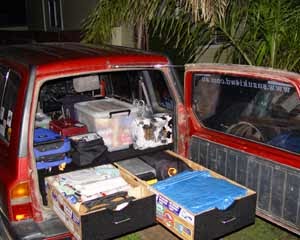
Marcus Wilson’s Vitara has a very useful two drawer storage system in the back, which forms the basis of an extended false floor system. It also houses part of his new doof-doof stereo system, and these wooden enclosures can also make excellent bass boxes if you have that type of sound system. The extra rear floor space also fits a BBQ quite well apparently!

My old Sierra had an asymmetrical false floor which could fit a set of packed plastic crates under it, but it also extended across the top of the passenger side wheel arch to give a much wider flat area on top. The driver’s side didn’t extend out, enabling tall equipment like a foldup table to stand upright, making it easy to grab for a quick lunch stop. It also provided a great acoustic chamber for my subwoofers, which were mounted along the front panel.

There are also some nice commercially available false floors with beautifully designed roll-out drawers. Burnie Morgan has one in the back of his GV and swears by it, although he points out they are not cheap to buy. However, they do come fully carpeted and finished, with heavy duty rollers, lock points, etc.

Grant Vella uses a similar system in his work vehicles. “I have a set of commercially built roll out draws in my work ute. We have 3 vehicles in the fleet fitted out the same. They are in constant use all day (our guys visit 8-12 customers per day) and have not missed a beat. Yes, they did cost $1400 each, but are a dream to work with.” says Grant.

Shelf Life


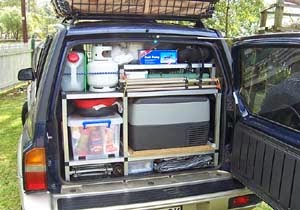
The logical extension of the false floor concept is to create a complete shelving system, customised to fit not only the car, but the particular way you pack. Because these can be built from scratch they can be designed to suit your fridge, your tent, your boxes, so packing truly does become like a well designed jigsaw puzzle. The most impressive one I saw was built by Tim Steele to fit into the back of his Vitara wagon. A marvel of engineering, it was created using Capral Aluminium’s Qubelock System. Qubelock is a collection of high impact plastic corner pieces in a variety of shapes which are designed to work with standard lengths of square aluminium piping – just cut to length and join together with the corner pieces to form whatever shapes you like.

Tim and Leah’s shelving system was designed to fit into their Vitara without the back seat installed, and has storage space for water, recovery gear, camping and cooking gear, as well as rollout drawers for food and fridge. Says Tim, “With that storage system Leah & I were able to pack a whole bunch of other stuff in the back of the Vitara. More than we needed sometimes... I remember Chris's comment on the Victorian High Country Trip – ‘What else have you got in there?!’ That storage system was the best thing since sliced bread. Took me bloody ages to build, but made camping life a whole lot easier.”

With the arrival of little Holly, they sold the unit to James and Amy who now use it in the back of their LWB Vitara. James says, “The storage system is second to none. Load safety has improved 100%. I would suggest a storage system to anyone that goes camping or 4WDing as much as we do.”

For the sort of trips we like to do, fitting as much gear as we need for two adults and two kids raises some interesting challenges. It requires putting more gear in, while having less space to do it with. With the inspiration of Mr Steele’s aluminium masterpiece, I decided to see what could be made to fit the back of our Vitara while still leaving the back seat in place. First step was to measure all the non-negotiable equipment such as the fridge and other camping gear. Our fridge, a 35 litre Waeco, was too long to fit lengthways into the back of the car, which is the normal way fridges are installed. With a bit of creative thinking, the plan was to create a rollout tray that held the fridge sideways instead.

After a couple of quick design sketches, it was off to Capral to buy the bits. I borrowed a dropsaw from a good mate so the cuts would be neat and clean and in a couple of hours had a finished product.

The good things about it are the snug fit and three tiered shelves. The back and sides of a Vitara body slope inwards slightly so you need to account for these subtle shape changes in the design by varying the size of the shelves. Slab sided 4WDs like Sierra’s won’t have this problem. It becomes an important consideration in being able to fit and remove the unit from the car… the back door is actually smaller than the inside space, so you need to be a bit clever in the way it’s designed or you can end up wasting space rather than saving it.

A good storage unit will hold everything in place and won’t rattle. We also have a cargo barrier installed to keep us safe from flying gas bottles and axes, so whenever we use the storage unit we just cable tie it to the mesh of the cargo barrier. The barrier doesn’t support any of the storage unit’s weight, but cable tying it into place stops it from moving or rattling.

Rattle and Hum


Speaking of rattling, a well packed Zook should experience very little of it. If you pack well and think about what items are likely to be resting up against other items, you can try to avoid obvious rattles and shakes. Cooking pots and billys are a good example; to save space try to buy pots that fit neatly inside each other, but to avoid rattles try laying a teatowel between them when you pack.

I was amazed at just how quiet the storage unit keep things. Even on rough corrugated roads at high speeds, there is almost zero rattle coming from the back of the car. If you are anything like me, that is a very important feature! I’ve been known to pull over and repack the car because of a minor rattle in the back. I really hate them. Apparently I’m not alone. Says Tim Steele, “We’ve found when packing plates, billys, camp ovens etc, (things that rattle), it's a good idea to place pieces of paper towel in between, or teatowels. Stops the rattles. Leah hates rattles.”

Buzz has more tips for keeping things quiet in the back of the car…”Don't forget packaging! It’s very important to prevent things rubbing together and wearing holes in themselves. If the Corn Flakes box is hard up against a billy handle it will rub through very quickly, and the flakes will go everywhere. The same goes for plastic bottles of oil or tomato sauce. Glass should always be wrapped to prevent breakages. Use pillows, blankets and other soft items to pack between bins and boxes to prevent rubbing of hard surfaces.”

Similarly, there will always be a certain amount of soft stuff you take with you – pillows, bags, parkas, etc – and these make useful padding which can be stuffed into all those hard to reach places, providing not only storage for the soft stuff but also helping to support and protect some of the other gear. Soft stuff is useful to pack against the windows too, as it can’t scratch the glass, or worse yet, the window tinting film. Constant vibrations on Outback roads can do quite some damage if you have things resting up against the glass.

Beware of flying objects


With the car fully loaded, it can be quite dangerous if you are involved in an accident or the unthinkable should happen and you roll the vehicle. Everything in the back becomes a missile, and if Murphy’s Law holds true, these missiles will be stopped by your cranium. That can hurt.

I’ve already mentioned cargo barriers, and although I think they seem quite expensive for what is essentially a piece of metal mesh on a frame, I highly recommend them. Not only are they much safer, but they really do assist in helping pack more in, as you can pack all the way to the roof.

As an alternative, Buzz again has a suggestion. “I added ratchet strap anchor points to my old Vitara. One set on the wheel arch near the rear door and the other set on the downward curve of the wheel arch below the seat height. These were simply D-handles bolted through the metal skin of the vehicle with spring washers and nylock nuts to retain them. Cost me about $10 plus $30 for two inexpensive straps. This is partly why I didn't get brained when I rolled last Christmas. Only a few things shifted.” Good advice Buzz.

Lighten Up


Roof racks and/or a roof carry basket can be helpful for carrying a whole lot of extra stuff, especially the light, yet bulky stuff like sleeping mats and bags, clothes and even tents.

In our roof basket we fit the tent ( a big one) 4 sleeping bags, 4 sleeping mats, 2 tables, 3 or 4 clothes bags, foldup chairs and other assorted stuff. To keep it dry we use a Bushranger Rack Sack which is quite water and dust proof. We moved the Rola roof racks back as far as they go so the basket can be packed by standing on the rear tailgate or rear wheels.

Having the load on top seems to make almost no difference to the balance of the car. It drives just as well with the load on or off, but I still try to keep the weight on the roof to a minimum, mainly to reduce the stress on the actual roof structure. By the time you add road vibration and wind resistance, you can be adding more stress than just the weight of the load.

Roof bars also provide a useful way to carry long items like tent poles, or even tents. Some tents fold down into long packages and are ideally carried on the roof.

Shop Around


When you buy camping gear, think about how it works in with your back-of-car jigsaw puzzle. Look at the spaces you have available and shop accordingly. There are lots of very cool items on the market which fold down to some amazingly small sizes if you consciously go looking for them. The trick is to buy items which fit your packing plan and not just whatever brand or style the particular shop sells. Be choosy!

It’s also worth looking in the bushwalking sections of the camping stores too, because in many ways we have similar sorts of space and weight restrictions, and you can often find good ideas from products designed for bushwalkers.

Finally, speaking of weight restrictions, if you do a lot of serious camping and touring you will probably be quite loaded up. I used to pull into the weighbridge at Marulan every now and then on trips just to see how much the Sierra weighed fully laden and it was always surprising! The Sierra has a tare weight of about 800kg, so the weighbridge guys were always amused when it weighed in at well over 1500kg. Obviously, all that extra weight can stress the suspension components fairly heavily so if you plan to do a bit of touring then upgrading the suspension with stronger and more robust components is a good idea. The extra weight can also make your Zook handle differently too, so just be aware of it as you throw it into unsuspecting corners.

When it comes to packing it all in, there are tons of good space-saving ideas out there if you keep your eyes open and use your imagination. Many of the best ideas will be gleaned from seeing how others do it, and that’s one of the great advantages of being in a club. Many of the ideas in this article were gathered from other club members, and in fact there are a few more I couldn’t fit in but are worth knowing, so you might like to browse over to the website forum and take a peek. To those who contributed, thank you.

There is so much expertise and experience in this club that if you simply ask for ideas you’ll get more than you know what to do with.

Chris Betcher
August 2003
CB2801 And DBZ00K

April 26, 2003

Fraser Island with the Betchers

I originally had this trip on the Club trip calendar, but took it off for a couple of reasons. The main one was that it was turning into a bit of a mammoth visit-the-rellies trip and it was becoming harder to accurately say we would be somewhere at a particular date and time and actually do it. The other reasons are that we didn’t really think it all that appropriate to run a club trip in competition with the Jamboree, and with four kids under the age of 8 tagging along it seemed a bit much to inflict on innocent club members. So the trip was removed from the trip calendar and we did it as a private trip with ourselves, the Salemes and Donna’s brother’s family in a hired Landcruiser. I took the opportunity to make our visit into somewhat of a reccie however, so hopefully you will find it being offered again as a club trip in the next 12 months or so.

It’s been a long time between visits for us and the Island has certainly changed a lot in 15 years. It’s noticeably more commercial, and I was quite shocked when we actually hit tar at Eurong township! My recollections of Eurong were that of a general store, a petrol pump, and that’s about it.

We left Sydney and headed up the New England highway, stopping at Aberdeen to visit my nan, then cruising on to Tenterfield for an overnight stop. Next morning saw us driving across the Queensland border, through Warwick, Ipswich and into Brisbane for lunch at South Bank. While having lunch in Brisbane, we got the message about Leah and Tim having their baby, so we had a little celebration for them. After lunch we jumped onto the Bruce Highway and heading for Gympie and Hervey Bay.

Arriving at Hervey Bay in the late afternoon we stocked up on supplies at the local supermarket and headed for the local van park where we’d booked an onsite van for the overnight stay before catching the 9:00am barge from River Heads the next morning. Donna and I caught up with a old teaching buddy who now lives up that way and we had a nice barbie on the beach at Torquay and got a few lessons in the laidback Queensland lifestyle.

Next morning we all drove down to River Heads and lined up for the barge. Anthony and I loaded our little twin blue V6 Vitaras on the barge amongst a sea of great big white Landcruisers – it was quite funny to see. After such a long drive, it’s a good feeling to finally be on the barge, sun shining and water shimmering, as you make your way over to Fraser in the distance.

Once on the island at the Woongoolba Creek loading point, we made our way over to Central Station for a look at the camping options. I’d been really keen to camp at Lake Mackenzie, but a Queensland National Parks ranger we met on the barge had been telling us it was the worse place on the island for dingos, and it had some of the girls a bit worried about the kids. Although Gary was pretty happy with Central Station, I hate camping on sloped ground and Bernadette was pretty keen to be near water, so we pushed on to Mackenzie to see what we could get there. It’s pretty difficult to get a site at Mackenzie as there are only 16 spots, you can’t book them, and they are highly sought after. We couldn’t believe our luck when we managed to get three sites! Nice level sites, at the end of the camping ground and only a short stroll to the lake. We decided to stay.

The next few days were spent tooling around the island, exploring the lakes, the beaches, the inland tracks and the resorts. All the tracks around the island are soft sandy roads and are a lot of fun to drive on. It rained on the Thursday and it was amazing how the rain changed the tracks – they became hard packed and much easier to drive on, although they still had lots of big undulations to give your suspension a decent workout.

On Tuesday we visited the beach via Eurong and drove all the way up to Indian Head and the Champagne Pools. We stopped at all the interesting spots along the way – Eli Creek, The Maheno Wreck, Happy Valley resort. I’d heard that Darwin Cheung and his family were also going to be on the island so I asked about him at the resort - they said he was staying there but had gone out for the day. We happened to bump into them when we dropped back into Eli Creek later in the day.

Eli is just beautiful. It’s a crystal clear spring that rises somewhere in the middle of the island and flows out to the sea, and it’s popularity with the island’s visitors is easy to understand. We spent some more time swimming up and down the creek, or rather, walking up the boardwalk and then floating back down to the beach, carried along with the current flow. Good stuff!

We had a few spots of rain – some quite big spots at times – over the next few days, but it didn’t dampen our interest to see more of the island. Over the next couple of days, we visited Central Station again and did the rainforest walk, and learned some very interesting facts about the islands spiders – facts I’m glad we didn’t know earlier! The Salemes joined us for a drive down around the southern lakes where we saw Boomanjin, Benaroon and a couple of others whose names I can’t remember. Got to have a run along an old airstrip too, but we just couldn’t get airborne.

The dingos were a bit of a non-issue… we saw quite a few of them, but none were a problem. A couple wandered through our campsite at night a few times, but they really are pretty timid and I think so long as you stay out of their way, they really aren’t looking for trouble. I think it’s a shame they get such a bad rap.

We eventually left the island on Friday afternoon, doing the long drive back down to Hook Point, got straight onto the barge and was back on the mainland at Inskip Point all too soon. A quick drive down the beach to Rainbow and we took the opportunity to get a high pressure hose under the car to wash out the salt and sand and then we headed for the Gold Coast, where Movie World was on the agenda for the next day. The Salemes stayed on the island for another day as they were off to visit rellies at Maroochidore the next week.

Spent the next few days getting home via Gold Coast, Nambucca Heads, Casino, Grafton, Macksville, (including a very scenic drive across the main range on about 150kms of gravel) and back home via Armidale, Tamworth, and Aberdeen.

It was a great trip, and we’ll have to do it again soon as a club trip when the weather warms up.

Chris, Donna, Alex And Kate Betcher
DBZ00K
March 2003

February 02, 2003

Advanced Driver Training Weekend

It was a dark and stormy night. No really, it was. It rained cats and dogs all night. Laying in the tent listening to it pelt against the tarp, it just seemed to continually step up a level in intensity, without ever dropping back. I haven’t heard rain like it for a long, long time.

But let’s rewind the clock a little. We were camped in the Casuarina camping area of the Watagan State Forest, having just enjoyed a terrific day of learning about 4WD recovery techniques. The weekend had been organised by Darren Smith and was aimed at giving people a chance to learn some of the important, but thankfully rarely used, techniques for getting your Zook out of serious 4WD trouble.

The weekend was well attended. I’m not sure of the exact numbers, but it was a great rollup, with 13 cars meeting at the Wyong Caltex at 9:30, and still more just turning up at the campsite. After a chance to pitch tents and get set up, we eventually got down to the business end of things, with sessions in using a high-lift jack, power winching and hand winching. Darren divided the group into three and they rotated from session to session every 45 minutes.

Unfortunately, I didn’t get to see either the power winching or high-lift jack sessions, as Buzz and I were running the hand winch session. It’s a pity as I would have enjoyed learning from the other guys too. Regardless, it was great to see so many keen and enthusiastic people coming along to learn about hand winching. I really like hand winches, as they are so versatile – I managed to buy myself a little 800kg Tirfor many years ago at and it has gotten me out of trouble more times than I care to remember. I like the fact that they can pull from any direction. To prove the point, we “bogged” the Vitara pointing downhill and needing a recovery from the rear – a situation a power winch would find very awkward.

As each group came through, Buzz and I got them to set up a direct straight-line pull, a round-the-corner dogleg pull, and finally a snatchblock pull to see how you can use a pulley to reduce the effort required to extract the vehicle. All the groups get very hands-on, laying out the cables, setting up the winch points, shackling equipment together, and of course, getting physical doing the actual winching. People asked good questions (especially Thomas and Nicholas), and we had a chance to talk about a range of recovery ideas for a variety of different situations.

Overall, the feedback was great and there was a general good vibe about the day. I’m pleased Darren made a distinction between Driver training and Recovery training… I’ve always believed that Driver training was about how *not* to get into trouble in the first place, while Recovery training was about how to get out of it. When you look at the things we covered on the day, it had everything to do with recovery and almost nothing to do with driving. I like that.

After the main sessions, we were all treated to a session on airjack lifting from Nicholas and a session on using tyre pliers from Thomas and Dayton.

With heads full of recovery bravado, a group decided to venture down Creek Road to see how wet it was. Surrounded by monster Sierras, full-on Patrols, and Celia’s Vitara, DBZOOK felt a little out of place once we got to the bottom of the creek. The steps up the other side were really muddy and wet, and proved quite a challenge to the groups. Celia got up on the second attempt, thanks to her twin lockers and Simex tyres (and good driving ability of course). Pete Bailey got up under his own power, not a bad feat considering the state of the track, and in fact he was the only other one to do it. A few others made it up, but only with a bit of snatch assistance. It was a good play session.

Back at camp, we settled in for the night. Dinner was had and a great session was had around the fire telling jokes. There are some funny bastards in this club! Thanks Mick, Dayton and the others, but the “crack-up” award has to go to Ax for his string of Leb jokes. Good one Ax! We even had an STD, but names will not be disclosed here.

We eventually retired to tents about 12:30, all joked out.

During the night was when it really became very dark and stormy. I woke up about 2:30 and it was absolutely bucketing down. The heavy rain made it difficult to sleep.

In hindsight, it was a good thing that I didn’t sleep well. I was awake about 6:00 so decided to get up and I figured with the tracks so wet I’d pack up and get an early start back home. After breaky I packed the tent, folded the tarp and was ready to go. I started the car’s engine to warm it up and then went for a final walk around the campsite to say my goodbyes, but as I was talking with Karen we heard a loud crack, and looked around to see a huge tree fall directly across the front of my Vitara! I’m assuming all the overnight rain had somehow weakened the timber and caused it to break. It hit the car above the drivers side A pillar, then smashed the front of the car, deforming the bonnet and guards, pushing the hinges clean through the metal. The windscreen was completely shattered of course. I was really upset about it, but even more shaken by the fact that had the tree come down during the night, or even just a little bit earlier, or had I decided to sleep in, the tree would have come down directly on top of my tent, with me in it. I was a really scary thought, and kind of put the damage to the Vit into perspective.

It was still driveable, so we very carefully drove the car back down the hill into Cooranbong and tried to make arrangements with the insurance company to get it towed back to Sydney. Everyone from the club was very supportive and helpful. I think I was still in a bit of shock, so if I didn’t say thanks – thanks.

I haven’t heard from the insurance company yet, but given the damage, I’m not really expecting to get the Vitara back. I suspect it will be a total loss. ? What a bugger… I really liked that car.

Chris Betcher
DBZ00K
February 2003

PS As it turns out, they didn't write it off, but decided to fix it. I'm pleased about that.

January 15, 2003

Not the New Year’s Eve Trip

Just lately, I’ve been doing a bit of travel up to Coffs Harbour, and as I gaze out the window of Virgin’s 737s, the mountains to the west of the coast have become increasingly alluring. The mountain ranges of the mid north coast extend well away from the coast, and from the air one can still see numerous tracks and trails running through them. I’d become quite fascinated by the possibilities this whole area might hold for 4WDing, and promised myself that it would be good to get up there are take a look around some time. So when Buzz announced his Not the New Years Eve trip into the forest regions around Wauchope, it immediately seemed to be the chance I was looking for to go exploring the area.

We Betchers had originally planned to drive up the coast with the Hammos on the 28th, but due to unforseen circumstances we ended up leaving later that morning and just met the others up there. The trip was uneventful, and slow… the traffic travelling north was unbelievable, with major delays at all the usual spots – Karuah, Bulahdelah and Kew. I can’t get over how many people have no idea how to merge from two lanes into one! It seems that the simple act of merging, and allowing another driver to pull into the space in front of you, really brings out people’s mean-spiritedness and aggression on the road. Anyway, I digress.

Our first shock as we arrived at the beautiful Swan’s Crossing campground was to see Buzz’s restyled Vitara looking much more like a Honda HRV. Seems he had a little “off” and reshaped the roofline somewhat. We were filled in on the awful details by Hammo and Di at the campsite, and informed that Michael and Krissie had taken Buzz to Port Macquarie hospital for treatment. He was a very lucky boy to walk away from it.

After settling in to camp, we took a quick explore of the area, walking up to the Top Hole swimming area. The campsite was stunning… a large flat expanse of green, with tall timber surrounding it on all sides and a charming creek running past our camp. The kids swam and enjoyed it, while the adults took to relaxing around the campfire.

Michael and Krissie eventually returned from the hospital at about 11:00pm after transporting Buzz back to his parents’ place near Byabarra.

Rain during the night and into the morning left many of the tracks quite damp, but the sun shone periodically during the day. A few of us decided to go explore the area, so a convoy of cars headed up the track from the campsite and onto the main ridge. Although Buzz had spent quite some time doing reccies and planning trips, without his expertise we were limited to some blind exploring of our own. Map in hand, we travelled across some good forestry roads, some steep and narrow logging tracks, as well as some tar roads into the surrounding district. After a brief stop at the Mt Comboyne lookout to take in the view, we drove out to the village of Comboyne itself where we had a pleasant picnic lunch in the park, and on to the amazing Ellenborough Falls. I wish we had a little more time here, as the falls dropped over a height of some few hundred metres into a large swimming hole, and it would have been great to do the walk into the valley and take a swim in it. Another time.

After some ice creams and my attempt to gas the locals, we headed back through Comboyne and past the “sleeping cow” towards camp. It certainly is a pretty area and was so green that it seemed almost surreal. A bit like turning the colour up on your TV so that everything seems exaggerated beyond normal. A small detour down a logging track was aborted after it got steeper and wetter and more slippery. As defacto trip leader for the day, I decided to play it safe and call it off when our car, with reasonable tyres, started sliding down the track several metres at a time. With other cars in the group running standard tyres, we decided that without a winch and without knowing what lay ahead, the smart thing was to back out. That was a little easier said than done, and the Hammomobile was used to assist The Harris’s XL7 back up the hill. Michael found out just how critical tyre pressure could be in such a situation, after going from immobile to mobile with a change of only 2 psi. The trip back up the hill took a little while but was quite a lot of fun.

Next day was superb weather, so a trip the beach at North Haven was the go. Buzz was right about the area… there is plenty of variety and things to do. It was actually quite nice to be able to camp in such a pretty and comparatively remote spot, yet still be so close to amenities like beaches and towns. We frolicked on the beach for a while before eventually heading back to camp and then moving out for another drive around the local area, this time with Buzz at the helm.

A drive to the very top of Mt Comboyne took us to a fire observation tower where we met a nice young bloke whose job was to sit in the tower all day and look for bushfires (seriously!)

More logging tracks, more trails - some quite steep ones – where Dave and Liz showed how clever their Subaru was, and Mike C showed us what a good little bus his ex-roo-shooting Sierra ute was. We found some nice loose and rutty hills to play on, with rewarding views at the end of them, and after a very full afternoon of exploring we swung via the pub at Wauchope for supplies and cheap oysters, then back to camp via Byabarra and the Buzzmeister’s mum and dad’s place. With an interesting detour in the dark we got back to camp about 9:00pm.

Brian and Dave showed us why butter knives are not the ideal tool for opening oysters, and Krissie pulled out her guitar and songbook, and another nice night was spent around the campfire.

Waking to more perfect weather on the final day of 2002, many of the crew had trouble getting started this morning. With deliberations still going on as to how to spend the day, Donna and the kids and I decided to drive up to Port Macquarie for the day and see the sights. After a bit of shopping, lunch in the pub, and a sightseeing sea-plane flight over the local area, we returned to camp to begin preparing for “the feast”. New Years Eve was planned to be a huge communal dinner and it was superb. Nibblies and drinks evolved into a virtual cornucopia of gastronomic delights - French casserole, roast chicken, garden salad, dips and chips, apple pie with cream and custard, and more… yumm! It was a great way to spend NYE.

We saw in the New Year with singing and dancing around the fire – it was very tribal – and the final countdown was marked with sparklers and horns, kisses and hugs and a great time by all.

It was great to get to know a few more people in the club, including many I’d not met before. A big thanks also needs to go to Buzz for organising the trip and making it possible for us to come enjoy the area, under what turned out to be fairly regrettable conditions for him.

Chris Betcher
DBZ00K
January 2003

October 26, 2002

The Best Kind of History Lesson

I was never a big fan of history at school. Oh sure, there were some fun bits, like hearing how the ancient Egyptians used to pull dead peoples' brains out through their noses, or how Henry VIII used to lop the heads off any wives he got fed up with, but by-and-large, history seemed pretty dull to me. Of course, Australian history was even worse… it was full of people like Leichhardt, Sturt, and Burke and Wills, who went off exploring inland Australia… big deal.

And that's the fascinating thing about history. When it has no relevance there is nothing quite so boring. But when you manage to get directly involved in it and see the sights and go to the places in which this history actually took place, it suddenly takes on a whole new meaning and interest.

Like most people, I knew the names Burke and Wills. They were those explorer dudes who went off across Australia looking for goodness only knows what and I can't even remember if they found it or not. I'm sure I must have been away the day they taught that in school. I remember something about a "Dig Tree", whatever that was, but never knew anything about what it was or what relevance it had.

Then a while ago, while researching the trip to Cameron Corner, Innamincka and Coongie Lake on the web I started to see lots of references to Burke and Wills, the Dig Tree, and the exploration of inland Australia during the second half of the 1800s, but still really had no idea what it was all about. However, when my son came home from school one day saying he had been learning about the Burke & Wills expedition of 1861, and explaining to me what the Dig Tree was all about, I began to take a renewed interest in it. It's funny how seeing things through your kids' eyes changes it for you.

So by the time the trip came around on Friday the 4th of October, it was with some enthusiasm and excitement that we set off to meet the troops and head to Cobar in central NSW. Arriving at Lithgow McDonalds in good time, we met Dave and Jen Shappcott in their 'Cruiser and Tim and Leah Steele in their V6 Vitara. It wasn't long before we were all on our way, with the two V6 Zooks and the Landcruiser eating up the kilometres between Lithgow and Cobar. We took the last hundred kays or so quite easy, very aware of the number of dead roos scattering the sides of the highway and not wishing to add to the tally.

We met up with Monica at the motel in Cobar and everyone got together that evening for a very enjoyable dinner at the local club/pub.

I had a discussion with some friends recently where we were debating exactly where the ''outback" starts. My contention was originally Dubbo. After you drive through Dubbo the land gets very flat and the roads start to straighten out. I think I've changed my mind though. There is a much more pronounced change to the landscape once you pass Cobar - the road passes through low scrubby land filled with saltbush and the distance between towns increases dramatically. It was this sudden expansion of distance and the reality of the vastness of the Australian continent that would later make the achievements of these early Australian explorers so evident.

We eventually swung north through Wilcannia and headed up the dirt to White Cliffs. White Cliffs is an interesting place. An opal mining town with a population of between 100 and 200 depending on
the time of year, most of the town lives underground and thanks to Donna, we were lucky enough to get invited in to visit one of the gentlemen that live there. We drove up onto the hill at the edge of the town where many of the dugouts are located, and Donna went for a wander to see what she could see. Next thing we know, she's managed to meet a fellow by the name of Jim, and he's invited us in for a look around his house. He told us he works in Broken Hill for part of the year and comes up to White Cliffs the rest of the time. We got to see his "extensions"… every time he wants a new room in the house, he just gets a jackhammer and makes one. Sometimes the rooms even pay for themselves, as he showed us where his "hallway" revealed quite a profitable opal vein. After that we went for a drive around the town, popped in to see the Underground Motel, the old Solar Power station, and of course, no visit to White Cliffs would be complete without a visit to Joe's Opal Shop. Made entirely of beer bottles embedded in concrete, the walls of the house form an effective insulation against the outside heat. Many years ago, Joe used to encourage visitors to engrave a message into the glass circles of the bottle bases in the walls, but he no longer does this. However, we still managed to find a bottle engraved with "Suzuki 4WD Club of NSW - Jimny Club of Japan, Outback Trip 1988" - a leftover from the Club's outback trip with our Japanese counterparts back in the Australian Bicentennial Year.

After a pleasant round of drinks and pool at the pub that night, (where due to an apparent time zone difference, Alex was suddenly 12 years old), we retired back to the campground for the night. We set off bright and early the next morning heading for Tibooburra via Milparinka and the Silver City Highway.

Tib is your typical quiet Outback town, but when we arrived there we had to fight for petrol bowser space with about 50 other cars that were part of a fundraising "bash" organised by the Cobar Rotary Club. We got a few raised eyebrows and comments about our "little buses"; some of these fellas seemed surprised to see Suzukis being used as serious outback touring vehicles.

We then made a quick stop at the local National Parks and Wildlife Office where we had a bit of a chat to Ingrid the Ranger. She gave us her advice on road conditions and the best ways to go. It's always worth checking in with the local rangers when you head Outback, as she suggested we take a completely different route to the one I'd originally planned, and it turned out to be a much better choice. She told us some of the horrors of the drought situation, including some awful things that were happening to the local kangaroos. She was also pretty concerned about the state of the roads, saying that they had not been graded properly for ages because it was just too dry to do it, and warned us that by the time we got back to Bourke the endless corrugations would make us "feel like killing somebody!"

Sturt National Park is rather unique and not at all what you might imagine when you think of National Parks. Very dry, very flat, very dusty and very rocky, the road took us out through stony gibber plains, across the famous Jump Up territory, and eventually headed north until we were running parallel along the Vermin Proof Fence. The fence, sometimes known as the Dog Fence or the Dingo Fence, is the longest fence (and in fact the longest man-made structure) in the world. Starting in South-East Queensland and finishing near the coast along the Great Australian Bight in South Australia, this section of the fence almost forms the boundary between NSW and QLD. (It's actually a few metres north of the real boundary we later discovered.) We stopped for photos, and then headed off towards our evening camping spot at Fort Grey.

Fort Grey, so named because it was originally the site of a supply stockade by the early explorers, is situated on the edge of Lake Pinnaroo, one of the Outback's many ephemeral lakes. It was completely dry of course; in fact many of the gum trees in the region had started to drop leaves in an attempt to survive the incredibly dry conditions. The region has not seen rain since June 2001 - over 16 months.

Next morning we headed towards the Corner. I was actually a little disappointed with the drive out there - when I was last in the area about 14 years ago with the Bicentennial Trip, the road to the corner was little more than a couple of sandy wheel ruts that travelled over countless red dunes. It was quite an adventure, cresting the soft red sand dunes, making your way to the Corner of NSW. Nowadays, with all the tourism in the area, the track to the Corner is a wide graded "highway", often laid with white gravel to make the ground firmer. Although still quite corrugated in places, it was a far better road than I expected and in some ways made the trip less of an adventure. It was still good fun being out there, just not what I expected. I suppose that's the price of progress.

After doing our border crossing and taking photos of our cars going through the gate, we stopped in at the Corner Store for fuel and supplies and visited the actual Corner marker. The state boundaries were originally surveyed by John Cameron, hence the name. The kids, including the big kids, all had turns at being in three states at once.

From here we headed out into the enormous expanse of parallel sand ridges that form the edge of the Strzelecki Desert. Again the road was quite good, wide and graded, as it headed west. We were able to drive at a reasonable pace, and found that if we approached the dunes at around 90 kilometres an hour we got a wonderful weightless sensation as we went over the top. We could feel the suspension unload as we crested each ridge, and then absorb the trough as we came down the leeward side, much like a giant rollercoaster ride. It was good fun, and had the kids giggling their heads off in the back seat.

From here, the road progressed through Bollards Lagoon Station property, and then gradually turned north until it met the Strzelecki Track at Merty Merty Station. We had the option of travelling along the Strez itself, or using the Old Strzelecki Track, so we opted for the latter. It was actually a pretty good road, very dusty and fairly corrugated in places, but we found that by choosing your speed it could be driven on at a good pace so the corrugations were not too severe. There is really no good speed for driving on outback corrugations - too slow and you feel every jolt in the road and too fast finds you hitting unexpected potholes and bulldust. One the whole we found it better to go a bit faster and just keep our wits about us.

The Old Strez eventually rejoined the New Strez, and took us towards Innamincka along possibly the worst road I've ever travelled across. It was made entirely of gibber stones, and was one of those roads that was uncomfortable at any speed. One of the things you become aware of very quickly when driving through the Outback in a Suzuki is the narrower track of the vehicle compared to the Toyotas and Nissans which form the bulk of the traffic out here. Driving in the wheel ruts of these bigger vehicles is an interesting exercise, as the Zooks tended to sit on top of the raised trail of stones which form between the wheel ruts. This gives you an often awkward feeling of falling either left or right into the ruts of the bigger vehicles. It's a driving technique that eventually comes together with practise, but it does take a little getting used to, especially at speed. We found that every so often one of the ruts would "grab" a bit more that the other, and it was easy to get into a pretty interesting tramlining situation if you weren't careful. There were a few occasions when I found us pointing in a slightly different direction to the one I expected.

Innamincka at last and we refuelled again, bought supplies and had a great lunch at the pub. It was here I kept seeing lots of references to the famous Burke and Wills expedition, but still didn't really understand what it was all about. I saw a book about Burke and Wills in the General Store, and although tempted to buy it, decided not to for some reason.

Our destination that night was Coongie Lake, about 100 kilometres North-West of Innamincka. Coongie is a permanent body of water, fed by the Cooper Creek. Cooper Creek is poorly named - not actually a Creek at all, it forms one of the largest river systems in Australia, with a watershed stretching across most of northern Queensland, and along with the Diamantina River forms the enormous expanse of land known as Channel Country. Dry for most of the year, the Cooper is capable of filling quickly when it rains in the catchment area, which can be thousands of kilometres away from Innamincka. There are however, a number of permanent or semi-permanent waterholes along the Creek such as Burke's Waterhole, Cullyamurra Waterhole and the beautiful Coongie Lake system.

The trip to Coongie started out OK on some fast and smooth desert roads, but soon deteriorated into a pretty rough and bumpy track. The last 10 kays into the lake area were atrocious and I think we were all pretty pleased to get there. But get there we did, and it was well worth it… quite literally an oasis in the desert, Coongie is a large shallow lake right in the middle of nowhere. Because it is the only permanent source of water for miles around, it attracts a great number of birds, and the drought only increased its popularity with the local birdlife.

We set up camp right on the shore of the lake, but only after we had a chance to cool off in the milky waters. Monica especially found the water a treat after having so much dust pouring through the open soft top of her little Suzy for the last few days.

We really enjoyed our time at Coongie. It was nice just "sitting on our dots" with very little to do except read, play games or swim. We managed to entertain ourselves quite nicely. We had a chat with the folk camped down the beach from us in a couple of new Nissan Patrols, and they have turned me off ever owning a Nissan (like THAT was ever going to happen!) They blew an injector pump near Dubbo and were stuck there for a few days while they had to wait for parts to be flown up from Melbourne. What a great way to spend your holidays.

After two nights at Coongie, it was time to head back to Innamincka to then head west along the Cooper itself. We pulled into Innamincka to refuel and restock, and also to ring Hammo to offer or apologies for being unable to attend the club meeting that evening. He actually sounded like he would have quite liked to have been travelling with us on our adventure through the outback rather than sitting in his office counting beans, but it's hard to be sure about these things over the telephone. I'm sure he was quite happy to be at work really. We also bumped into our friends in the Nissans again… this time, it seems one of the cars had blown a turbo and was facing a 750 km "nurse" drive into Broken Hill, where another long delay waiting for parts seemed inevitable. Seems the Nissan advertising phrase "just wait till you drive it" was proving very accurate for these folk …

While in the Innamincka store, I also decided to buy that book about Burke and Wills I had been considering on my previous visit a few days earlier.

Heading out of the town on "the worst road in Australia" (apparently), we then headed east towards Cullyamurra Waterhole, the largest waterhole on the Cooper Creek. On the way there we took a slight detour to see the very spot where Burke died back during his fateful expedition of discovery.

Burke's place of demise is under a big old Coolabah tree on the banks of the river. Marked by a stone cairn with a simple plaque stating "Robert O'Hara Burke, died here, 28 June 1861", it was an amazingly understated tribute to one of Australia's most significant explorers. I suppose if you've got to die, there are worse places it could happen. There was a certain eeriness though; walking along the bank of the creek, knowing you were walking in the footsteps of the famous expedition which took place 141 years earlier.

The next two days camped along the Cooper were wonderful. We happened to find a canoe by the river belonging to the Innamincka Hotel, so decided we should probably mind it for a few days. It was a good way to explore the river, and we all had a go of paddling our way around the creek. Like Coongie, Cullyamurra Waterhole was also a haven for birdlife and we managed to spot lots of locals in the trees surrounding our campsite… pelicans, eagles, crows, sparrows and a very majestic kite who kept us enthralled with his soaring directly overhead for hours on end.

This campsite was the only one we were able to have a campfire, so we made the most of it that night, and the Steele's cooked up a delicious roast. I became enthralled in the Burke & Wills book, sitting reading it and feeling the need to glance up every so often just to take in the surroundings which were being described so vividly within the pages of the book. It was bizarre reading about the history behind the expedition, and then getting to the part where they were camped along the Cooper, and here I was, sitting on the same land they traversed all those years ago. The story described the gibber plains to the south of the creek - and I could glance to my left and see the reddish orange of the gibbers through the trees. There's nothing like being there to bring the story to life. It really was the best kind of history lesson.

Our trip home took us out to the actual Dig Tree - Burke's infamous Camp 65, where he took Wills and 2 others on a desperate sprint to the Gulf to claim his position in history as the first white man to cross the continent from south to north. The debacle of that story, of how they returned to camp on the same day the support team at camp 65 left for Menindee, and how they covered their tracks so it looked like no one had been to the camp, and the ensuing comedy of errors that followed… it gave me goose bumps to actually BE there where all of this Australian history took place. To stand at the tree and see "B LXV" (Burke's camp 65) engraved into the tree and look around the see the spot by the river where he and Wills must have been digging up the camel chest to get the supplies… it was quite eerie, and very humbling to have spent the last few days travelling through this amazing country in an air-conditioned 4WD, but being able to more fully understand the incredible hardships that the heat and dust and vastness must have put these people through.

Had I simply read about all this in a book it would have meant very little. To actually be there, standing in the shade of the Dig Tree, staring out into the vastness of the great Australian continent, was a truly awe inspiring feeling. I don't think there is any way someone could truly appreciate just how enormous an achievement it was for these pioneer explorers unless they had actually been out there and seen it and experienced it for themselves.

The trip home from there was long, but straightforward. A change of plans saw us heading west through Queensland out to Noccundra and Thargomindah, instead of the route originally planned through Warri gate and back to Tib. Leaving Thargomindah the next morning had us heading south through Hamilton Gate back into NSW for the long drive home. Our original plan to stop at Nyngan for the night was shelved and we eventually drove all the way back to Sydney that day, with stops in Bourke, Dubbo and Orange - a total day's drive of over 1250 kms.

It was a great trip, with great company and some stunning scenery. If you've never been out that way, all I can say is do it. You may never really appreciate the true spirit of the Australian landscape until you do.

Chris Betcher
DBZ00K
October 2002

July 17, 2002

Zookimelt - The Big Picture

How can you explain a phenomenon like Zookimelt?

Individual people from all over the world, people who have never even met each other, who have nothing in common except for their choice of vehicle, getting together in a global show of solidarity. It's not like we are trying to change the world or anything. We simply all went for a drive. Just got in the car, and went for a drive.

But there was something special about the fact that we all got in cars that had something in common. All over the world. Different languages, different timezones, different continents. Same spirit. Quite remarkable when you think about it really.

You see, while we were trundling along through the Gardens of Stone National Park in Lithgow, there were other people doing the same in their little corner of the world. Some likeminded Americans were doing the zook thing over in the Badlands Offroad Vehicle Park in Attica, Indiana. On the other side of the globe, the members of the Samurai Club of Portugal were doing their thing too. So were fellow zooksters in Thailand, England and New Zealand. The Ba'Zuki group in Sweden were doing it Swedish style and of course the Jimny Club of Japan were doing it in the land of the rising sun.

So what? What's so special about the fact that a bunch of people all went for a drive on the same day? I guess it's pretty trivial really, I mean we just went for a drive and had a bit of fun in our cars, right?

Maybe, but maybe it's bigger than that. I really enjoyed the day, even though Lithgow has never really been one of my favourite places. (though it is growing on me!) But I had a real sense that we weren't just going for a drive… that we were part of something much bigger. That we were a part of a global family who shared something in common even if it was just something as silly and insignificant as all driving a particular make of 4WD.

I remember a few years back we invited some members of the Jimny Club of Japan out to Australia, and the most remarkable thing about the week or so that we spent travelling together was the fact that despite our lack of common language, we actually had a lot of other stuff in common. We would look under the bonnets, point and gesture at things and we knew what each other meant. We camped together, sat around campfire and spoke with our hands. The 4WDing experience became like a common language that held us together… it was quite remarkable. And another time I recall going to Bali and having all these conversations with other Suzuki owners who didn't speak a whole lot of English but who gladly let me poke around their cars, checking out stuff that was different to what I'd seen in Australia. I owned a Suzuki - I was a friend.

And over the next few weeks, we'll start to see stories emerging over the Internet of how the world's Suzuki clubs celebrated Zookimelt. And you'll hear stories and see pictures of how someone else in some other part of the world just went for a drive too, but don't lose sight of the bigger picture.

Most of the world's governments can't get people to cooperate globally like the world's Suzuki Clubs did on July 13/14, 2002. There are places in the world where they blow each other up simply because the other guy's a bit different. You can watch countries bitch and fight about all sorts of stupid issues just because they can't seem to agree on how things should work or who should be in charge or what colour the other guy's skin is.

So when you think about Zookimelt, think about what it stands for. On a single weekend in July, a bunch of people from all over the world, who were separated by oceans but not by passions, just got in their cars and went for a drive.

And that's how the world should be.

Chris Betcher
July 2002